


The Indian criminal justice system relied on the principles of natural justice. If any of the principles are denied, the whole proceeding is vitiated. Opportunity of being heard is a cardinal principle of natural justice which is to be followed in the criminal case for the purpose of fair trial. Fair trial implies that the accused is provided with an opportunity to defend himself. The accused must not be torn off from his right to receive a fair trial. And the same can be ensured by the accused himself when he is present during the trial proceedings. Also, in case of the conclusion of any trial, the accused needs to be present in the court to receive the sentence given to him.
Since the presence of accused is essential for fair trial and where the summons for the attendance of the accused person is to be issued, but the court believes the accused may abscond or when the accused fails to appear before the court without any reasonable cause, a warrant of arrest is issued. Now, the warrant of arrest has been issued, and there is reason to believe that the accused has absconded or is hiding himself to avoid the execution of the warrant.
The court may publish a written proclamation requiring the accused to appear before the court and may attach his property.
If the accused fails to appear after the proclamation as well, the court may also attach the property of the accused, and the property will be at the State Government’s disposal.
These provisions have been dealt with under sections 82 to 86 of the Criminal Procedure Code.
The term proclamation means that a person accused of an offence is absconding and he could not be traced out for effecting arrest with the help of warrant. And therefore, the Court requires to make a publication in writing to make the accused aware that he is required to appear at a specified place and at a specified time not less than thirty days from the date of such publication. This publication is called proclamation.
When such proclamation is published and the accused is declared by the Court as a proclaimed offender anyone can arrest the accused from anywhere and hand over him to the nearest police station as a proclaimed offender.
And the term attachment means, the Court issuing an order of proclamation may simultaneously issue an order to attach the movable or immovable property of the accused. Effect of the order of attachment is that the property, movable or immovable, comes within the purview of legal encumbrances.
These seemingly harsh measures are important as financial sanctions impel the person to come to the Court. Therefore, before an order of proclamation is issued, what the Court must ensure is that it has the reasons for issuing such an order.
An order of proclamation without sufficient cause would be illegal and therefore any consequent action arising out of that order like attachment would be deemed illegal as well. Therefore, much turns on the fact that whether the Court’s satisfaction that the person has absconded or is concealing himself is justified or not.
The meaning of the word “absconding’ thus has invited a lot of attention. Now, it is obvious that the word has a sense of continuity to it. A person cannot be said to have absconded if he was not present in the house for that day. Absconding would occur if a person would run away hastily or secretly so as to avoid the legal process.
The primary meaning of ‘abscond’ is to hide and when a person hiding from his place of residence, he is said to ‘abscond’.
As per Dictionary meaning, the word ‘abscond’ has been defined as to hide or to quit the country in order to escape a legal process.
Written Proclamation for person absconding (Section 82)
As per 82 (1) If any Court has reason to believe (whether after taking evidence or not),
Then, such court may publish:
As per section 82(2) The proclamation shall be published as follows-
Section 82(3) A written statement by the Court issuing the Proclamation,
Proclamation, which was duly published:
Section 82 (4) Proclamation published under section 82(1) is in respect of a person accused of an offence, punishable under section 302, 304, 364, 367, 382, 392, 393, 396, 397, 398, 399, 400, 402, 436, 449, 459, or 460, Indian Penal Code, 1860, and such person fails to appear:
Court may after making such inquiry (as it thinks fit):
Provisions of section 82(2) and (3) shall apply to:
Case Laws :
K.T.M.S. Abdul Qader Vs. Union of India AIR 1977 Mad. 386, F.B.
Held: Even though the person left India before the passing of the detention order if they continued to remain outside India with a view to defeat or delay the execution of the detention orders, they have to be taken to be absconding persons.
Kanwar Singh Case 1893:
Under S. 82, the previous issue of a warrant against the person concerned is a necessary condition. Therefore, if the Court has no jurisdiction or authority to issue a warrant, an order for the issue of a proclamation would be illegal.
Vellayappa,A.I.R. 1942 Mad. 289:
The Madras High Court has held that if, after the issue of the warrant, the Magistrate is informed that the accused had already left India when the warrant was issued, a proclamation under this section cannot be issued, as the accused cannot be said to be wilfully absconding when he could not have known of the warrant.
Shewdyal, – 6 W.R. 73:
Under this section, it is necessary that the person must have absconded or he must be concealing himself so that the warrant cannot be executed. It, therefore, follows that the mere fact that the Sub-Inspector could not find the accused is not enough.
Moltan Singh. 21 Cr. L.J. 210:
The accused must be given at least 30 days for appearance. If the date fixed for this appearance is less than 30 days (from the date when the proclamation published), it is illegal, and all subsequent proceedings (like attachment and sale) will also be invalid and may be quashed.
Mian Jan vs Abdul 1905 :
It was held in the case that a proclamation which does not mention the time within which the absconder should present himself is equally void.
Indradeo vs State of West Bangal 1973 : It was held by the Supreme Court that Non-compliance with the requirements of S. 82 would be a non- compliance with “the procedure established by law” within the meaning of Art. 21 of the Constitution.
Section 83, Attachment of Property of Person absconding: Section 83 empowers the Court to attach the property of any person concerned against whom a proclamation has been issued.
This section penalises a person who seeks to avoid his arrest under a warrant and against whom a proclamation is issued under the previous section. For disobedience of the proclamation, incurs liability to be punished under section 174 of the Indian Penal Code. This provision is devised to put additional pressure upon the absconder by depriving him of his property with a view to compel him to obedience.
However, in order to attract the penal consequences mentioned in this section, the proclamation under the section 82 of this code should be a valid proclamation satisfying all the three clauses with regard to its publication.
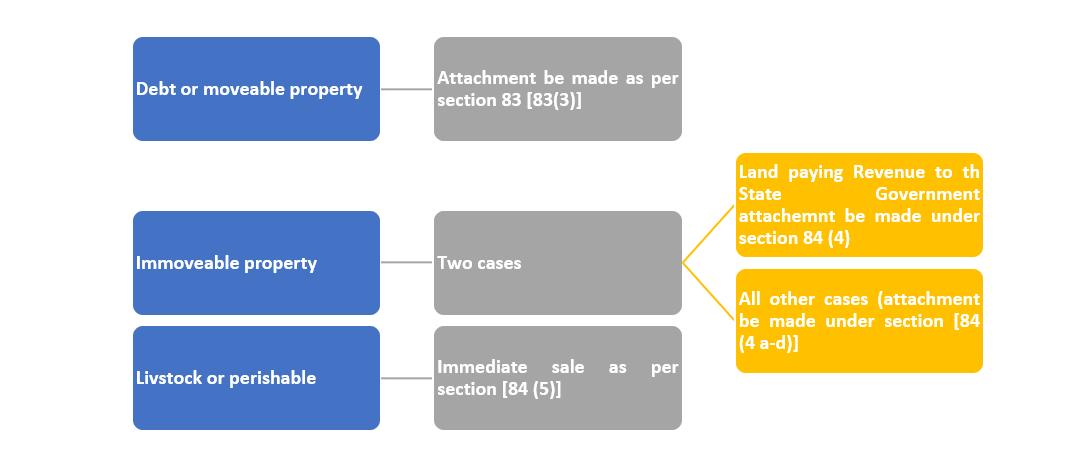
If the property ordered to be attached is a debt or other movable property, the attachment is to be made
If the property which is ordered to be attached is immovable property, the attachment is to be made through the Collector of the District in the case of land on which revenue is payable to the State Government.
In all other cases, attachment of immovable property is to be made-
Case Laws :
Mrs VG Peterson vs Forbes 1963 it was held by the Supreme Court that the provisions of the Code not being applicable to contempt proceedings, these sections cannot be availed of for securing the presence of the alleged contemnor or, in default, to attach his property.
Dayanand Kalu vs State of Haryana 1976 In this case, Supreme Court while emphasising the object of this code in the case of was held that the object of attaching property of an absconder is not to punish him but to compel his appearance. If the property has not been confiscated or disposed of, the title thereof continues to vest in the owner and thereafter in his heirs.
Ratish Roy vs Mohesh Singh 1984 In the case it was held that An order of attachment in the absence of the material to show that the accused was absconding was illegal.
Trigala Veeraya v. State, the Court laid down that the rights of the Government in case of attachment of a part of the joint family property are the same as any coparcener. As the coparcener derives an interest from the property, the Government too derives an interest and is therefore entitled to the income accruing from that part of the property. Section 84 relates to claims and objections regarding attachments. If a person, other than the person proclaimed person, has an interest in the property to be attached he may object to that attachment within six months. Section 85 talks about release of the attached property on appearance of the proclaimed person within the specified time and Section 86 lays down the rule regarding appeal from order rejecting application for restoration of attached property.
SECTION 84 CLAIMS AND OBJECTIONS TO ATTACHMENT : Section 84 provides a means to protect the interests of any person other than the proclaimed person in the attached property. Any such person who has an interest in the attached property can claim it within six months from the date of attachment on the ground that the claimant has an interest in the property and the interest is not liable to be attached under section 83 The claim shall be inquired into and may be allowed or disallowed in whole or in part.
As per this section
1) If any claim is preferred to, or objection made to the attachment of any property attached under section 83,
Then The claim or objection:
PROVIDED:
2) Claims or objections, to be preferred or made in which court there may be two kinds of cases.
Case 1: Claims or objections under section 83(1) : It may be preferred or made in the court by which the order of attachment is issued.
Case 2: Claims or objections in respect of property attached under an order endorsed under section 83(2) : It may be preferred or made in the court of Chief Judicial Magistrate of the district (in which the attachment is made)
3) Every such claim or objection shall be inquired into, by the court in which it is preferred or made.
PROVIDED that if it is preferred or made in the court of Chief Judicial Magistrate. Chief Judicial Magistrate may make it over for disposal to any magistrate subordinate to him.
4) Any person whose claim or objection has been disallowed (in whole or part) by an order under section 84(1). He has following remedies:
SECTION 85: RELEASE, SALE AND RESTRORATION OF ATTACHED PROPERTY:
Three terms have been used in this section regarding the disposing of attached property under section 83.
Release: As per section 85(1) property shall be released from the attachment if the proclaimed person appears within the time specified in the proclamation.
Sale – As per section 85(2) The proclaimed person does not appear within the time specified in the proclamation. The property of the attachment shall be at the disposal of the State Government. However, Government shall not dispose off the property by way of sale until: –
If the proclaimed person appears within the time specified in the proclamation, his property is released. If he does not do so within time, then his property will be at the disposal of the State Government. The expression “shall be at the disposal of the State Government” is also used in s. 458. It means that the property passes under the absolute control of Government to dispose of, or deal with it, in whatever manner might seem most appropriate and convenient.
The property unless it is perishable, is to remain under attachment for six months. At the end of the period, the property is to be sold and the sale proceeds to awaits for two years. If within two years, the person satisfies the court as to the reason for his absence, he can recover the money, otherwise it stands forfeited to the government.
In the case of Secretary of State vs Ahalyabai 1937 it was held that person having a claim to such property can enforce it by an independent action in a civil court so long as the property is not sold and remains in the hands of the Government.
Restoration– Restoration here means realising of attached property to the accused. As per section 85(3) the attached property shall be restored after satisfaction of the court Within 2 years from the date of the attachment.
Any person (whose property is or has taken at disposal of the State Government under section 85(2)):
If the property has been sold as per the provisions of Section 85 (2) then the following procedure will be adopted.
Under sub-section (3) it shall not be sufficient that the accused person appeared voluntarily within two years or was apprehended or brought before court, instead it must also be proved that he did not abscond or conceal him for the purpose of avoiding arrest and also that he had no notice of proclamation requiring him to appear before the court within the specified time. This proof must be offered or given within two years from the date of attachment of the property.
An application under sub-section (3) must be made by absconder himself.
It was held in M.C. Choudhary v. State, that the absconder should himself appear and prove such allegations within two years off attachment. An application made after two years for releasing the attached property is not entertainable. It was further held that where it is shown by accused that he had no knowledge that he was wanted in a criminal case and till his property had been attached on the ground that he was absconding and other accused persons except him were acquitted, it would be unjust & inequitable to confiscate the attached property of the accused for no fault.
SECTION 86: APPEAR FROM ORDER REJECTING APPLICATION FOR RESTORATION OF ATTACHED PROPERTY
Any person referred to section 85(3), who is aggrieved by any refusal-
The person may appeal to the Court-
The following four remedies are available to an aggrieved person in this connection:
© VIDHOON All Rights Reserved