


For there to be justice delivered, it is important that proper procedure is followed. And it is important that the procedure followed should be fair and reasonable so that there is no scope for the innocent to be punished and at the same time the procedure must ensure that the guilty must not go Scot- free. The procedure for arrest, detention, trial, judgment etc., is prescribed under the Criminal Procedure Code of 1973.The code defines bailable offence, cognizable offence, complaint, courts, offence, judicial proceedings, warrants case summons case etc. It is a complete code prescribing the classes of criminal courts, offices and their powers and jurisdiction. This code also prescribes for the police to act upon the crime along with their duties and functions. The procedure from the occurrence of crime to arrest, bail trial and prosecution, has been discussed in detail in the Criminal Procedure Code.
Documents and other material objects relevant for any investigation, inquiry or trial should be available to the agencies conducting such proceedings. If any person in possession or control of any such relevant documents or things does not cooperate with these agencies and fails to produce the things required, the law will have to device coercive methods for obtaining these material objects for the purposes of proper investigation or trial. The code therefore, provides initially for the summons to produce any documents or things, but if this method fails or apprehended to fail the court can issue orders to the police for the search and seizure of such documents or things. The Code also empowers the court to issue warrant for a general search of any place for the purposes for any inquiry or trial, or to issue warrants for the search of places suspected to contain stolen property, counterfeit coins or currency notes or stamps or obscene objects and such other objectionable materials. The exigencies of the investigation may require the immediate search of a place and the Code in such cases empowers the police to make a search even without obtaining a warrant from the Magistrate.
There are following ways to compel a person to produce a thing or document :
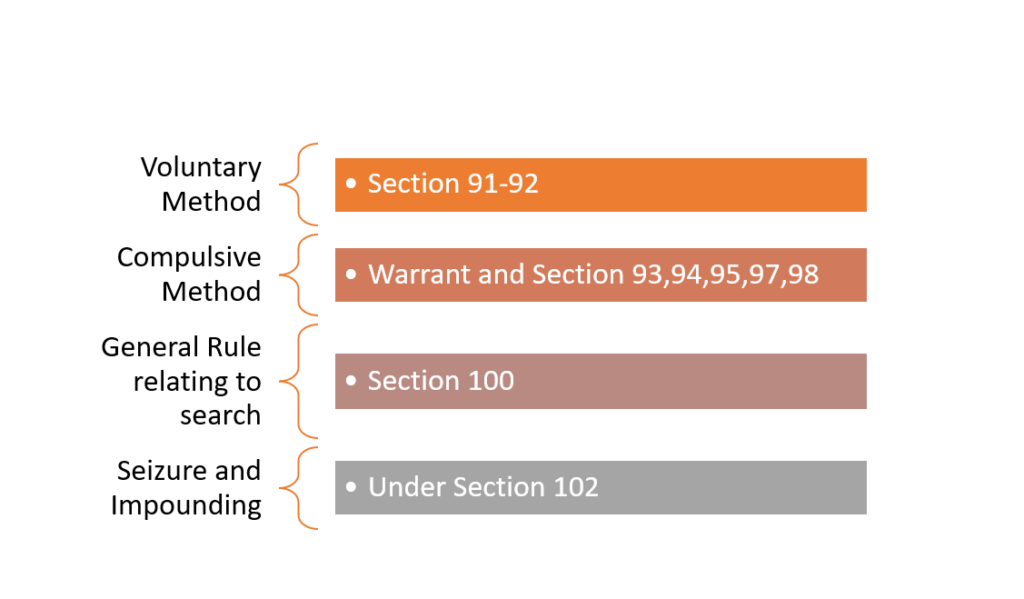
Section 91 Issuance of Summons:
Section 91 depicts about the procedure for the issuance of summons for the production of things or document. There are two authorities under this section who can compel the person to produce the things or document for the purpose of any investigation enquiry, trial or other proceedings. These two authorities are:
Such Summon or Written order as the case may be can be issued to person in whose possession or power such things or document is believed to be.
‘Document or other thing’-Thing : The word refers to a physical object or material and does not refer to an abstract thing. Issuing a summons to a person for the purpose of taking his specimen signature or handwriting cannot be said to be for the production of document or a thing contemplated under this section.
This section deals with documents forming the subject of a criminal offence as also with documents which are or can be used only as evidence in support of a prosecution.
The thing called for must have some relation to, or connection with, the subject matter of the investigation or inquiry, or throw some light on the proceeding, or supply some link in the chain of evidence. When an application is made to a Court, or to a police officer under this section, the Court is bound to consider whether there is a prima facie case for supposing that the documents are relevant, i.e., whether books of a particular type are likely to have a bearing on the case. If the Court thinks they are, then it can order production.
Person under this section- The term person does not include an accused person on trial.
Case Laws:
State of Gujrat vs Shyamlal 1965 : Supreme Court held that issuing such process against any accused shall be violation of article 20 (3) of Constitution. As it will negate the safeguard of the article because production of things or document in the knowledge of accused person can be discriminating evidence against him.
V.S.Kuttar Pillai vs Ramkrishna 1980 SC :
State of Kerala vs Babu 1988 SC:
Exception: Following provisions does not apply to this section:
Section 123 of Evidence Act: Affairs related to State
Section 124 of Evidence Act: Official Communications
Non-Compliance of Section 91:
Provisions in CrPC :
Section 92 : Procedure as to letter and telegrams:
And same is required for the purpose of any investigation, enquiry or trial may ask such authority to deliver that thing or document to the person as directed by such Magistrate or Court.
And same is required for the purpose of any investigation, enquiry or trial may-
Case Laws:
Samuels Case 1603: A man’s house is his castle because next to the person own freedom comes the freedom of his house. The maxim also forms part of the fabric of the Fourth Amendment to the Constitution,3 which protects people, their homes, and their property against unreasonable searches and seizures by the government.
Entrick vs Calington 1765: On 11 November 1762, the King’s Chief Messenger, Nathan Carrington, and three other King’s messengers, James Watson, Thomas Ardran, and Robert Blackmore, broke into the home of the Grub Street writer John Entick in the parish of St Dunstan, Stepney “with force and arms”. Over the course of four hours, they broke open locks and doors and searched all of the rooms. The King’s messengers were acting on the orders of Lord Halifax, newly appointed Secretary of State for the Northern Department, “to make strict and diligent search for … the author, or one concerned in the writing of several weekly very seditious papers.
Entick sued the messengers for trespassing on his land. It was held in the case that prerogative powers of the monarch and government are subordinate to the law of the land. It guarantees that government officials acting in an executive capacity “cannot exercise public power unless such exercise of it is authorised by some specific rule of law”. Hence Lord Camden ruled, as later became viewed as a general principle, that the state may do nothing but that which is expressly authorised by law, while the individual may do anything but that which is forbidden by law.
State vs Bhawani Singh 1968: It was held that search warrant should be used as a last resort for the mature concentration. searches under the Code of Criminal Procedure have to be conducted strictly in accordance with the formalities and within the legal limits prescribed in the said Code. An Indian citizen’s house, it must always be remembered, is his castle because next to his personal freedom comes the freedom of his home. Just as a citizen cannot be deprived of his personal liberty except under authority of law, similarly, no officer of the State has a prerogative right to forcibly enter a citizen’s house except under the authority of law.
© VIDHOON All Rights Reserved