


To meet the ends of justice, it is critical to produce the accused and other witness or related parties before the court whenever needed.
If the accused is found guilty at the conclusion of the trial, he must be present in person to receive the sentence. Also, his presence is necessary if imprisonment is to be enforced.
There are 6 modes under Cr.P.C to compel the appearance of persons before court: –
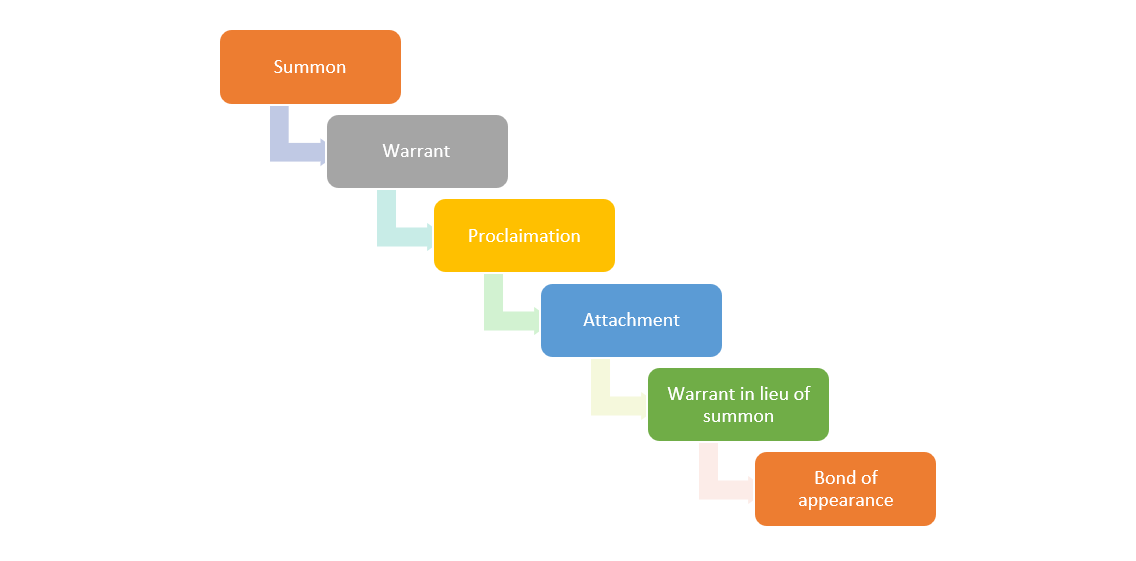
Summon is a legal document issued by a court in a person in a legal proceeding like accused or witness. In other words it is authoritative call to the accused persons to appear in court to answer to a charge of an offence.
Basically, it is issued for compelling –
Essential contents of summons are :-
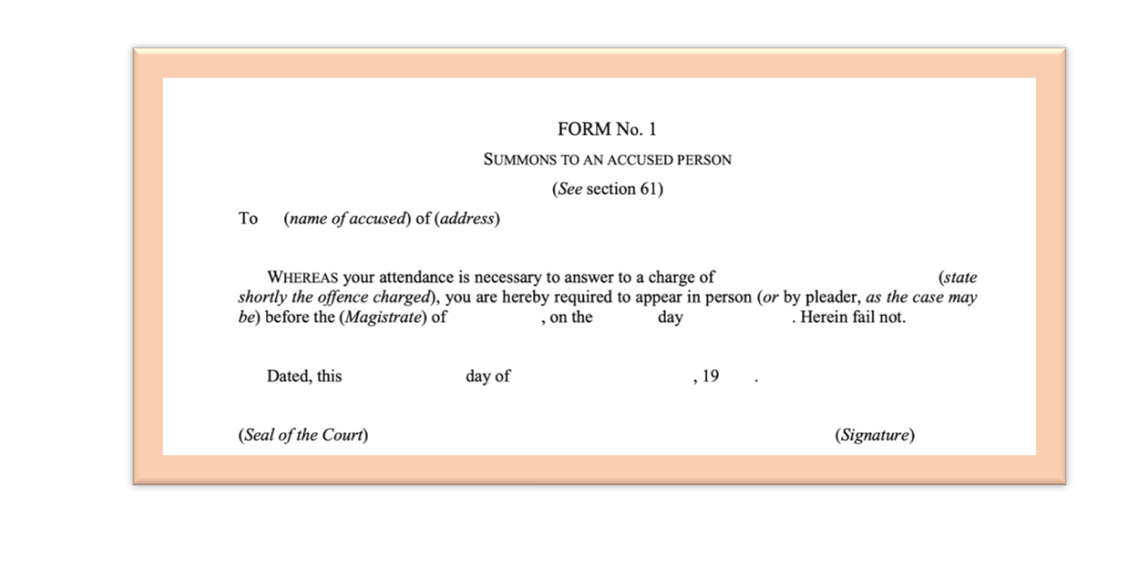
The form of summon to an accused person is given in schedule -II Form No. 1 of the code of criminal procedure code 1973.
General Summons (61-69) :
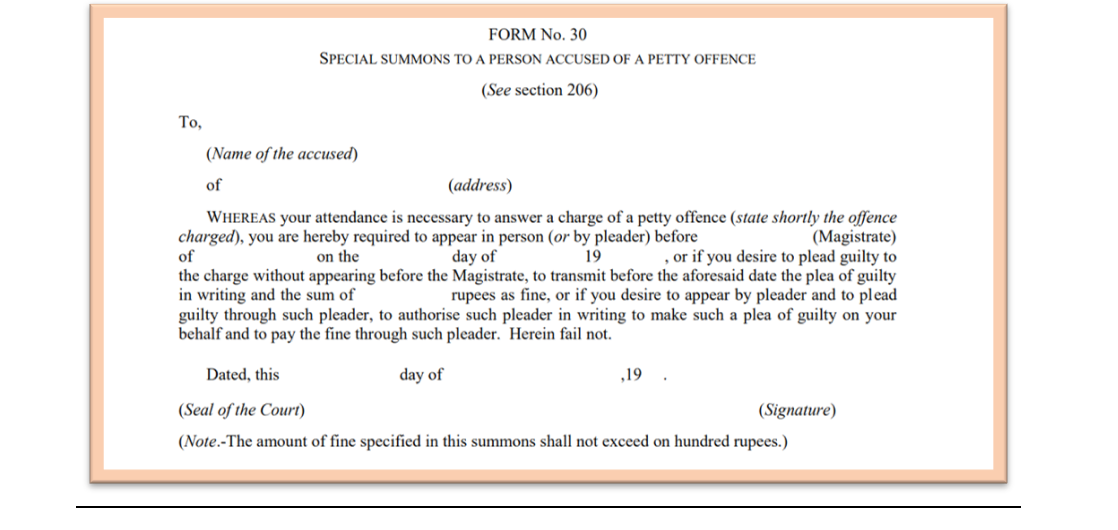
Special Summon : Section 206 Form-30 of Schedule-II of Criminal Procedure Code 1973
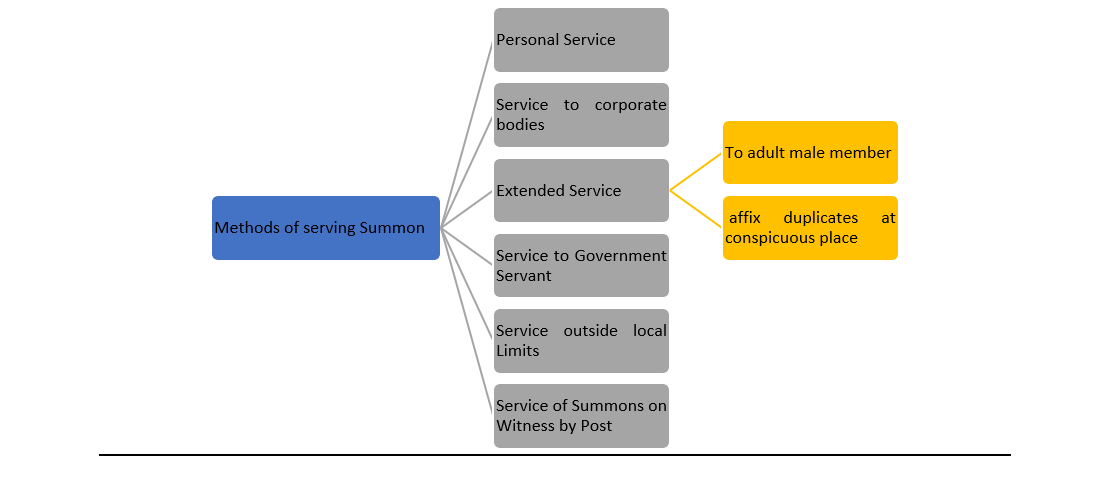
Personal Service (Section 62): Every summons shall be served by a police officer, or subject to such rules as the State Government may make in this behalf, by an officer of the Court issuing it or other public servant.
(2) The summons shall, if practicable, be served personally on the person summoned, by delivering or tendering to him one of the duplicates of the summons.
(3) Every person on whom a summons is so served shall, if so required by the serving officer, sign a receipt therefor on the back of the other duplicate.
Who can serve the summons?
Case Law:
E.Chathu vs Gopalan : Where the person sought to be summoned is employed abroad , the court , if it considers proper can send summons to the concerned Embassy official for the purpose of service. It was further held that officers working in the Indian embassy abroad are certainly ‘public servants’ whose assistance can be sought by court in serving summons.
Service to corporate bodies:
Service of a summons on a corporation may be effected through two ways –
Explanation. -In this section, “corporation” means an incorporated company or other corporate and includes a society registered under the Societies Registration Act, 1860.
Though societies registered under the Societies Registration Act, 1860, may not be formally incorporated, yet the Explanation by its inclusive definition brings them under the present section.
In the case of Central Bank of India vs DDA 1981 , that branch manager is a local manager and if summon has been served on him, the service shall deemed to have been effected on the company.
Extended Service:
A duplicate copy of the summons should be left with the person receiving it. Explanation clearly mentions that a servant is not a member of the family within the meaning of this section.
In Hemendra Nath v. Archana, 1971 CrLJ 817 (Cal) case, the Court held that to justify service under Section 64 of CrPC, it should be shown that proper efforts were made to find the person summoned.
In the new act which is now known as Bharatiya Nagarik Suraksha Sanhita now the extended service of summon can be done to any adult member of the family which includes male and female both.
Affix Duplicates at some Conspicuous Place: According to section 65 CrPC, when service cannot be affected as provided under sections 62, 63, 64, the duplicate of summons shall be affixed to some conspicuous part of the house in which the person summoned resides. This is also known as substituted service of summons.
Service on Government Servant: (Section 66):
According to section 66 , When a Government Servant is to be summoned and is in active service of the Government, then the summons in duplicate shall ordinarily be sent to the Head of the office in which such person is employed. Now, the head of the office is bound to serve the summon to such person in the manner provided under section 62 of the Code. And after obtaining signature on the back of the duplicate from such person, he has to return the signed copy with endorsement to the Court. Such signature shall be evidence of due service.
Service of summons outside local limits
There are two provisions regarding service of summons outside local limits which has been mentioned in Section 67 and Section 68.
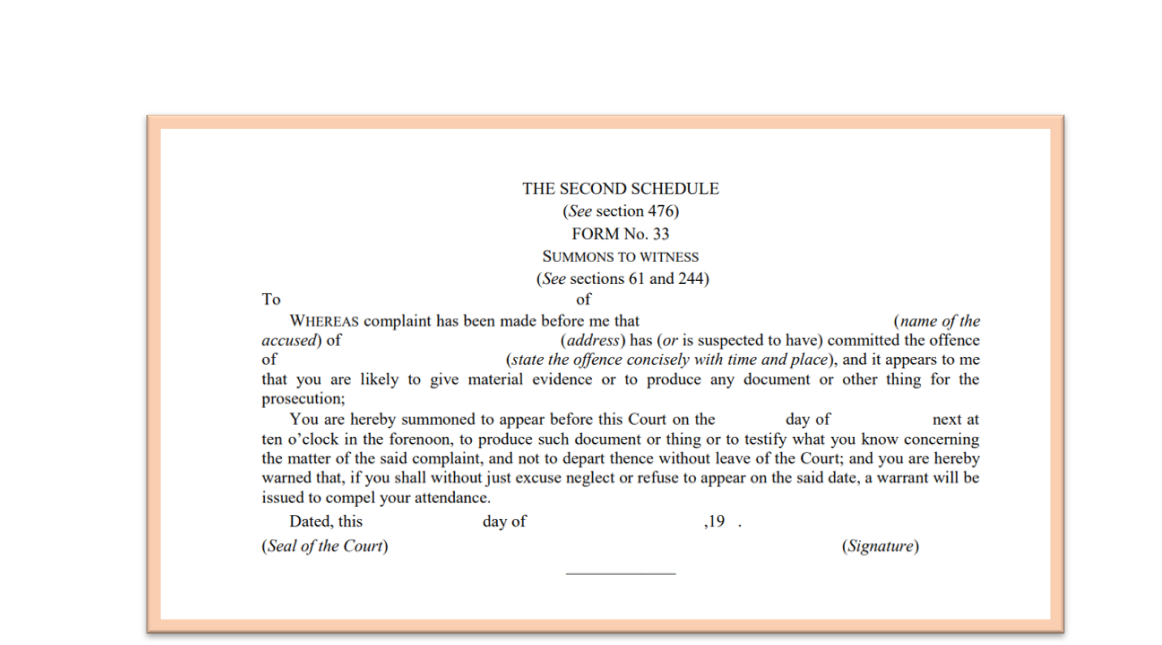
Service of Summons on witness by Post Section 69 The Code of Criminal Procedure, 1973: The Summons to witness can be served by post. It can also be served through registered post. When postman is delivering it to such person and he refused to accept it and the postman put a remark on it that the receiver refused to accept, then it is considered as evidence and the issuing Court may declare that the summons is duly served.
This section intends to avoid delay in the service of summons on witness. This section is confined to witness only, it means that summons cannot be served through this accused.
_____________________________________________________________________________________
© VIDHOON All Rights Reserved