


An admission is a statement of fact which waves or dispenses with the production of evidence by conceding that the fact asserted by the opponent is true. It is a voluntary acknowledgement made by the party or somebody identified with him in legal interest. The Supreme Court observed that admissions are very weak kind of evidence and the court may reject them if it is not satisfied from other circumstances that they are untrue.
Admission literally means acknowledgment of a fact. S. 17 defines it as statement, oral or documentary, suggesting an inference as to any fact in issue or relevant fact made by any of parties and under circumstances stated Us 18 to 20.
In CBI v. V. C. Shukla case, on 2nd March, 1998 distinguishing between admission and confession the Supreme Court observed: “Only voluntary and direct acknowledgement of guilt is a confession, but, if it falls short of actual admission of guilt, it may be used as evidence against the person who made it or his authorized agent, as an admission under section 21.
According to Section 17 of the Indian Evidence Act, 1872 an admission is a statement, oral or documentary or contained in electronic form, which suggests any inference as to any fact in issue or relevant fact, and which is made by any of the persons, and under the circumstances, hereinafter mentioned.
Section 17 IEA defines “Admissions” but it is not complete definition. It is complete when it is read with other provisions of the Chapter especially Ss. 18 to 20.
Example:
A, files a suit against B alleging that B is the last male owner’s daughter’s son and that he (A) is the last male owner’s sapinda. B files a document in which A admits that B to be the daughter’s son of the last male holder. That document is the admission made by the A.
There as two types of admissions:-
Judicial Admission:
The judicial or formal admission is addressed to the court and is the part of the proceeding. It is made on the record in the file of the court. The judicial admission may be made by the party in his pleading, or by stipulation, or by statement in open court.
In Bishwanath Prasad v Dwarka Prasad, AIR 1974 SC 117 case, the Supreme Court opined that “admissions, if true and clear, are by far the best proof of the fact admitted.” Admissions as defined in Sections 17 and 20 and fulfilling requirements of Section 21 are substantive evidence, propio vigare (of or by its own force independently).
Extra-judicial Admission:
The extra-judicial or informal admission is statement of fact made by the party previously in course of life or business which is inconsistent with the facts to be established at the trial. The extrajudicial admissions are called evidential admissions. The Evidence Act only deals with this sort of admission in Sections 17 to 23.
In Bessela v Stern, (1877), L. R. 2 C. P. D. 265 case, where the girl said to the boy “you always promised to marry me and you did not keep your words.” The boy did not deny the allegation, but he offered her some money. The boy’s silence as to promise was held to be admission.
Relevancy of Admission:
According to Section 3 of the Indian evidence Act, one fact is said to be relevant to another when the one is connected with the other in any of the ways referred to in the provisions (sections 5 to 55) of this Act relating to the relevancy of facts. ” The admission is relevant on the following reasons:
The general principles concerning admission has been dealt with in following Sections:
_____________________________________________________________________
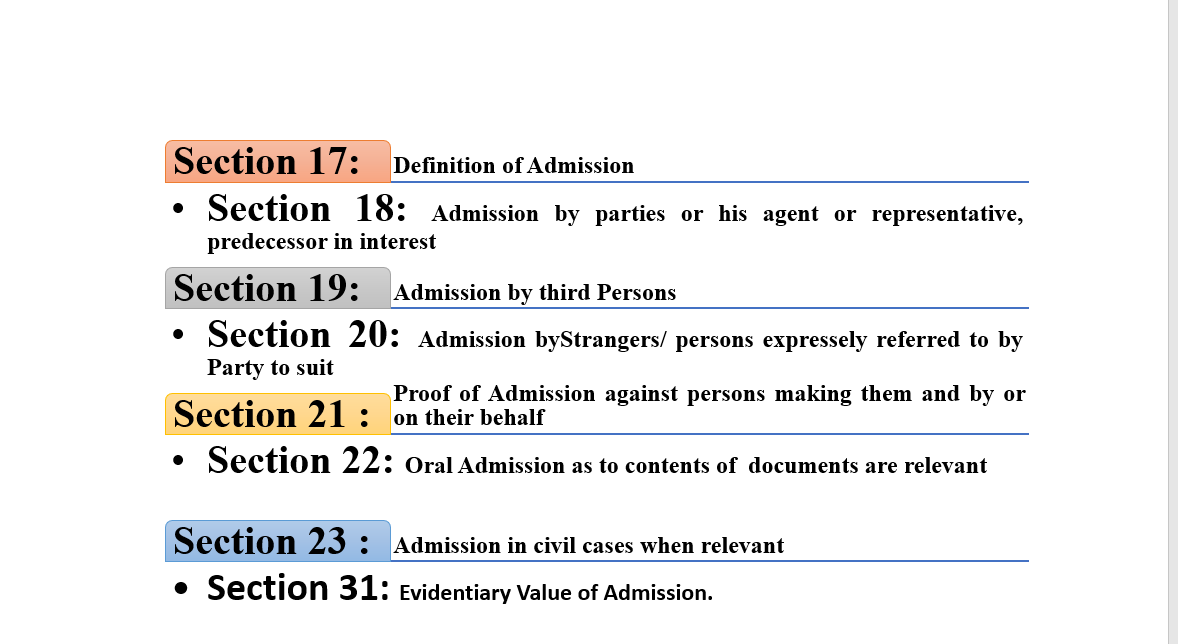
Secs. 18, 19 and 20 makes the statements of the following persons relevant:-
It is important to note that under Sec. 18, an admission by one of several defendants in a suit is no evidence against another defendant, for otherwise the plaintiff can defeat the case of the other defendants through the mouth of one of them. So a defendant is bound by his statements only to the extent of his own interest. So is true of the statement of a co-plaintiff. But since every plaintiff has a pecuniary interest in the subject-matter of suit, his statement can fall in that category.
In order to bind admission made by an agent, the following two conditions must be satisfied:
Thus, the acknowledgment of a debt by a partner is an admission against the firm. Likewise, admissions of facts made by a pleader in court, on behalf of his client, are binding on the client. But, an admission by a pleader on a point of law will not bind the client.
Sec. 19 deals with statements of persons whose position is in issue, though they are not parties to the case. The section is based on the principle that where the right or liability of a party to a suit depends upon the liability of a third person, any statement by that third person about his liability is an admission against the parties.
Section 19 enacts an exception to the general rule that admission by stranger or third party are not binding. However, if conditions stated Us 19 are satisfied, then third party admission are also relevant. In order to attract S. 19, the following conditions must be satisfied:
Illustration to Sec. 19 – A undertakes to collect rents for B. B sues A for not collecting rent due from C to B. A denies that rent was due from C to B. A statement by C that he owed B rent is an admission, and is relevant fact against A, if A denies that C did owe rent to B.
Section 20 enacts second exception to the general rule made under section 18 and states that admission by referees i.e. strangers are admissible. It is a tripartite arrangement as there are three parties i.e. one who refers; one who is referred; one to whom reference is made. The provision would be attracted where a party to a suit has expressly referred the matter to referee or stranger for making a statement irrespective of the fact that referee has any specific or particular knowledge regarding the subject matter. These are relevant but not conclusive unless they fall within the rule of estoppel under section 115 of Evidence Act.
To attract the operation of Section 20 , there must be an express reference for information in order to make the statement of the person referred to admissible.
Illustration:
The question is, whether a horse sold by A to B is sound.
A says to B – “Go and ask C, C knows all about it.” C’s statement is an admission
First part of Sec. 21 – “Admissions are relevant and may be proved as against the person who makes them, or his representatives in interest”
Sec. 21 lays down the principle as to proof of admissions. The section is based upon the principle that an admission is evidence against the party who had made the admission and, therefore, it can be proved against him.
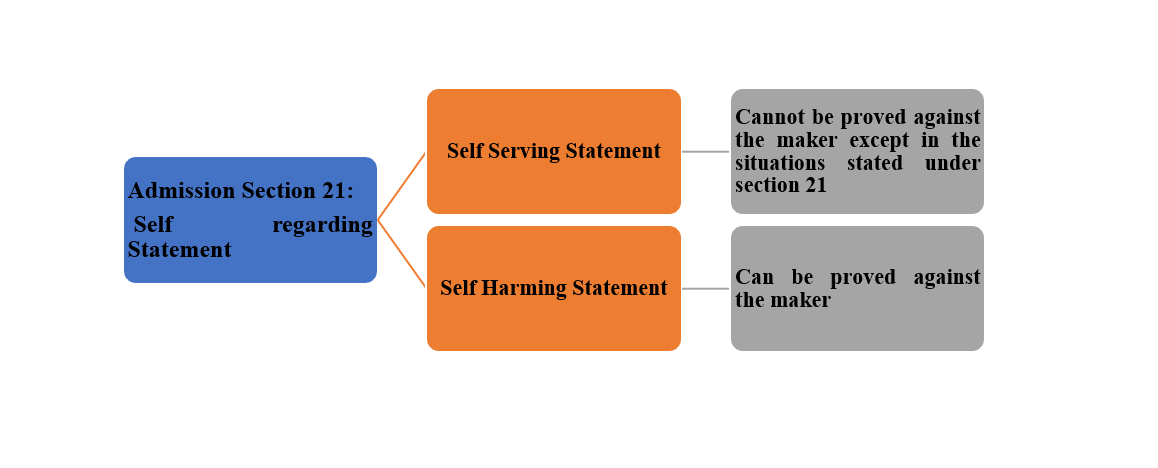
Any self-serving statement made under this section would be considered irrelevant unless it falls under the ambit of general exception as provided in second part of this section.
In R. v Petcherini (1855) 7 Cox. C.C.70: A spriest, facing the charge of blasphemy, was not permitted to prove his earlier statement to the effect that only immoral books should be destroyed.
A statement is in self-serving form when it is in favour of person making it and in self-harming form when it is against the interest of the maker.
For instance; A states that he is the owner of the property or that B owes him Rs. 2000/- are self-serving statement. A states that he is not the owner of this property or that A owes towards B Rs.2000/- are self-harming statement.
The general rule of relevancy with respect to such statement is that a statement in self-harming form is admissible but statement in self-serving form is not admissible. The reason for this rule is obvious; there can be no guarantee of truth of statement which is made to serve one’s own interest.
The Evidence Act reproduces the aforesaid principle in section 21 of the Act. It stipulates that an admission is relevant and can be proved against his maker or his representative-in-interest except in the three situations laid down below :-
Illustration:
If the question is whether a person has been guilty of cruelty towards his wife, he may prove his statements made shortly before or after the alleged cruelty, which explain his love and affection for and his feeling towards his wife.
Illustration:
Where the question is whether a person received a stolen property with knowledge that it was stolen. In order to prove that he did not have guilty knowledge, he offers to prove that he refused to sell the property below its value or natural price. His statement explains the state of his mind and is accompanied by the conduct of the refusal to sell. He may thus prove his statement.
Similarly, where a person is charged with having in possession a counterfeit coin with knowledge that it was counterfeit. He offers to prove that he consulted a skilful person on the matter and he was advised that the coin was genuine. He may prove this fact.
Case Laws :
Satrucharla Vijaya Ram Raju v Nimmaka Jaya Raju (2006) 1 SCC 212:
Where a person’s self-serving statement subsequently becomes adverse to his interest, it may be proved against him as an admission. “Though in a prior statement, an assertion in one’s own interest may not be evidence, a prior statement adverse to one’s interest would be evidence. Indeed, it would be the best evidence”.
Venugopal vs. A. Karrupusami (2006) 4 SCC 567:
Thus, stray statements in the deposition of the landlord showing that there was no personal need of the premises, amounted to an admission against his own interest in filing the eviction proceedings.
Delhi Transport Corporation v Shyam Lal AIR 2004 SC 4271
The admission of a bus conductor that he had taken money from a passenger without issuing ticket to him was considered to be the best piece of evidence against him. But he has a right to rebut it.
Chetan Constructions Ltd. vs. Om Prakash AIR 2003 A.P. 145:
Fact of the case was, the vendor of property admitted in his agreement, affidavits and other papers that delivery of possession was made to the purchaser on the date of the agreement, and subsequently he wanted to resile from admission saying that possession was only for sake of paper work, the court said that a heavy burden of proof would lie upon him to show that the statement was not true. The fact that a heavy amount was received for handing over immediate possession was strong evidence of delivery of possession and was not easy to be countered.
Admissions How Far Relevant (Secs. 22-23)
When oral admissions as to contents of documents are relevant (Sec. 22)
Oral admissions as to the contents of a document are not relevant, unless and until the party proposing to prove them shows that he is entitled to give secondary evidence of the contents of such document under Sec. 65, or unless the genuineness of the document produced is in question.
When the question is whether a document is genuine or forged, oral admissions about this fact are relevant. A document can be proved by the primary evidence (original document) or secondary evidence (attested copies or oral account).
Section 22 makes relevant oral admission regarding contents of document in the following two situations:-
When oral admissions as to contents of electronic records are relevant (Sec. 22A)
“Oral admissions as to the contents of electronic records are not relevant unless the genuineness of the electronic record produced is in question.
Admission in civil cases when relevant / Communication without prejudice (Sec. 23)
“In civil cases, no admission, is relevant, if it is made either upon an express condition that evidence of it is not to be given, or under circumstances from which the court can infer that the parties agreed together that evidence of it should not be given”.
Explanation – Nothing in this section shall be taken to exempt any barrister, pleader or attorney from giving in evidence of any matter of which he may be compelled to give evidence under Sec. 126. Sec. 23 gives effect to the maxim interest rei publicae ut finis litium (it is in the interest of the State that there should be an end of litigation).
Sec. 23 applies only to civil cases. When a person makes an admission “without prejudice”, i.e., upon the condition that the evidence of it shall not be given, it cannot be proved against him. This protection or privilege against disclosure is intended to encourage parties to settle their differences amicably and to avoid litigation if possible.
This section protects admissions or communications made without prejudice. It is applicable to civil cases. These are excluded on the ground of public policy. These may be made expressly or impliedly. In disputes parties generally exchange communication in order to settle the matter or buy peace but these are made with understanding that those would not be used in the court against them should the parties fail to settle the matter. Negotiations for compromise and statements made in the court during the process of making efforts for compromise or amicable settlement are not admissible under this section as these must be taken to be conducted under the implied understanding that that they would not be given in evidence.
Explanation appended to the provision stipulates that this provision shall not be taken to exempt any barrister, pleader, attorney or vakil from giving evidence of any matter of which he may be compelled to give evidence Us 126.
There are two provisions regarding the evidentiary value of Admission:
A statement made by a person mentioned in the sec 18 of the Evidence Act and, in the circumstances, mentioned in sec 18- 30 of the evidence act, which suggest an inference about the any fact in issue or relevant fact is an admission. It can be understood as anything a party has ever communicated either in speech, writing or in any other way in reference to the party at the trial is an admission. It is a positive act of acknowledgement of a fact or is a confession. It is not mere inference which is drawn by the any other act such as silence or implied consent. It must be conscious and deliberate act
© VIDHOON All Rights Reserved