
The term ‘evidence’ owes its origin to the Latin terms ‘evident’ or ‘evidere’ that mean “to show clearly, to discover, to ascertain or to prove”
According to Phispon
Evidence means, the testimony, whether oral, documentary, or a real, which may be legally received in order to prove or disprove some fact in dispute.
According to Taylor
Evidence is shown for the purpose to prove or disprove any fact, the truth of which is submitted to judicial investigation.
According to Advanced Learner Dictionary
Evidence means anything that gives reason for believing something that makes clear or prove something.
Evidence refers to anything that is necessary to prove a certain fact. Evidence is a means of proof.
Definition: Sec-3 of Indian Evidence Act, 1872: “Evidence” means and includes —
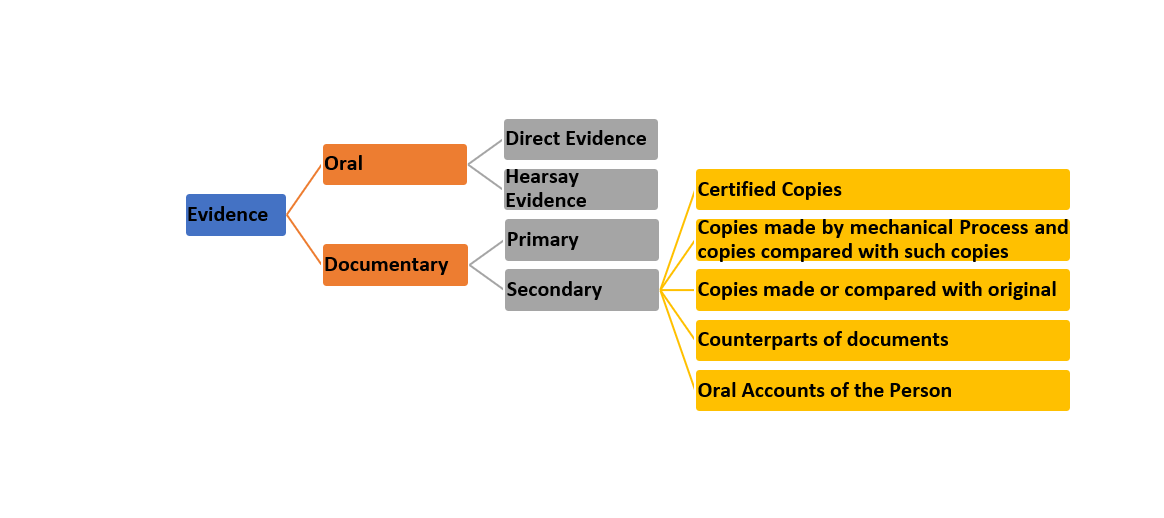
Documentary Evidence (Secs. 61-90)
Documentary evidence means all documents produced for the inspection of the court. Documents are denominated as ‘dead proof,’ as distinguished from witnesses who are said to be living proofs.’ Documentary evidence is superior to oral evidence in permanence, and in many respects, in trust worthiness.
Sec. 61. Proof of contents of documents – The contents of documents may be proved either by primary or by secondary evidence. There is no third method of proving the contents of a document.
The contents need not be proved by the author of document, and can be proved by any other evidence.
Banarsi Das v Maharaja Sukhjit Singh AIR 1998 SC 179:
In the absence of the documentary evidence which could have been available, the plaintiff was not allowed to rest his case on oral evidence which was against the record produced by the defendants.
Section 3 Documentary Evidence: The expression “Document” means any matter expressed or described upon any substance by means of letters, figures or marks, or by more than one of those means, intended to be used, or which may be used, for the purpose of recording that matter.
Illustrations: A writing is a document; Words printed, lithographed or photographed are documents, A map or plan is a document; An inscription on a metal plate or stone is a document; A caricature is a document.
Narsinga Rao v. State of Andhra Pradesh, AIR 2001 SC 318 :
The Supreme Court held that in order to prove the documents original document is to be produced. Contents of it are to be proved so also signature on the same have to be proved. When document appeals to the conscious of the Court that it is genuine, contents of the same need not be proved.
Ravichandra v. M/s. Elements Development Consultants, Bengaluru, 2018 Cri. LJ 4314 (Kar):
The Court observed that mere marking of a document cannot be said to be the proof of said document. The document has to be proved in accordance with law and the same has to be appreciated in order to ascertain the genuineness of the document with other materials available on record. In that context, both the parties would get ample opportunity to counter those documents as well to submit their arguments with reference to the evidence already recorded by the court.
Kinds of Documentary evidence: There are two kinds of Documentary Evidence.
When Secondary Evidence is Admissible ?
Section 65 : Cases in which secondary evidence relating to documents may be given :– Secondary evidence may be given of the existence, condition, or contents of a document in the following cases –
Secondary evidence, as a general rule is admissible only in the absence of primary evidence. If the original itself is found to be inadmissible through failure of the party, who files it to prove it to be valid, the same party is not entitled to introduce secondary evidence of its contents. Essentially, secondary evidence is evidence which may be given in the absence of that better evidence which law requires to be given first, when a proper explanation of its absence is given.
Case Laws :
M.Chandra v. M. Thangamuthu, 2010 AIR SCW 6362:
The Court said that: “It is true that a party who wishes to rely upon the contents of a document must adduce primary evidence of the contents, and only in the exceptional cases will secondary evidence be admissible. However, if secondary evidence is admissible, it may be adduced in any form in which it may be available, whether by production of a copy, duplicate copy of a copy, by oral evidence of the contents or in another form.
The documents obtained under RTI Act can be admitted as secondary evidence, as they are obtained under a particular enactment, which fall within ambit of by “any other law in force in India”
Other Provisions regarding Primary and Secondary Evidence:
Secs. 65A/ 65B (Admissibility of Electronic Records in Evidence):
Section 65A and 65B have been added by the Information Technology Act,2000. Section 65A lays down that the contents of electronic records may be proved in accordance with the provisions of Sec. 65B.
Sec. 65B lays down that “notwithstanding anything contained in this Act, information in an electronic record which is printed on a paper, stored, recorded or copied in a computer shall be deemed to be a document and shall be admissible in any proceedings (without further proof or production of the original) as evidence of the contents of the original or of any fact stated therein of which direct evidence would be admissible.
It is further laid down that the following conditions have to be satisfied in relation to a ‘ “computer output”:
Sec. 65B then lays down that for the purpose of evidence, a certificate identifying the electronic record containing the statement and describing the manner in which it is produced by a computer and satisfying the conditions mentioned above, and signed by an officer in charge of the operation or management of the related activities, shall be the evidence of any matter stated in the certificate; it shall be sufficient for a matter to be stated to the best of the knowledge and belief of the person stating it.
Rules as to Notice to Produce [Section 66]: Secondary evidence of the contents of the documents referred to in S. 65, clause (a), shall not be given unless the party proposing to give such secondary evidence has previously given to the party in whose possession or power the document is, or to his attorney or pleader, such notice to produce it as is prescribed by law; and if no notice is prescribed by law, then such notice as the Court considers reasonable under the circumstances of the case:
Provided that such notice shall not be required in order to render secondary evidence admissible in any of the following cases, or in any other case in which the Court thinks fit to dispense with it:
Sec. 66 lays down that a notice (to produce a document) must be given before secondary evidence can be received under Sec. 65 (a). The notice is to be given to the party who has possession of the original document, or to his attorney or pleader. Notice should be given in a manner as is prescribed by law, and if there is no law on the point, such notice should be given as the court considers reasonable under the circumstances of the case.
A question arises: when the opposite party fails to produce the original when demanded and the court has accordingly admitted secondary evidence, can the party in possession subsequently produce the original of his own choice ? The answer is “No”. Sec. 164 clearly lays down that where a party has required to another to produce a document and he has refused to do so, he can’t afterwards use the document as evidence unless he obtains the other party’s consent or the court’s order.
The requirement of notice under Sec. 66 is to be strictly complied with. The other party cannot be restrained from producing the original where the notice to produce has not been given, nor can secondary evidence be given in such case.
Section 67 (Proof of signature and handwriting of person alleged to have signed or written document produced)
“If a document is alleged to be signed or written by any person, the signature or the handwriting of so much of the document as is alleged to be in that person’s handwriting must be proved to be in his handwriting.”
Section 67A (Proof as to Digital Signature)
“Except in the case of a secure digital signature, if the digital signature of any subscriber is alleged to have been affixed to an electronic record the fact that such signature is the digital signature of the subscriber must be proved.”
Sec. 67 does not prescribe any particular mode of proof of signature or handwriting of a person. However, the following modes of proving a signature or writing are recognized by the Act, viz.
Section 68 (Proof of Execution of Document Required by Law to be Attested)
To attest is ‘to bear witness to a fact. A document the execution of which is required by law to be “attested” means a document the signature upon which should be put in the presence of two witnesses who themselves add their signatures and addresses in proof of the fact that the document was signed or executed in their presence. They are called ‘attesting witnesses’.
Attestation does not imply that the attesting witnesses have admitted to the contents of a document. Section 68 lays down that if a document required by law to be attested is produced as evidence, at least one attesting witness shall be called to prove the execution of the document. This principle will apply only if at least one of the attesting witnesses is alive, capable of giving evidence and subject to the process of the court.
Section 68 further provides that no attesting witness need be called in the case of document (not being a will), which has been registered under the Indian Registration Act 1908 and the person executing it does not specifically deny its execution. If there is a denial, then , attesting witness have to be called.
Section 69 (Proof where No Attesting Witness Found)
“If no such attesting witness can be found, or if the document is executed in the United Kingdom, it must be proved that the attestation of one attesting witness at least is in his handwriting, and that the signature of the person executing the document is in the handwriting of that person.”
Section 70 (Admission of Execution by Party to Attested Document)
Sec. 70 lays down that ‘where the party to an attested document has admitted that he executed the document that is sufficient proof of the execution even if the document is required by law to be attested’. This admission’ relates only to the execution and to be made in the course of the trial of a suit or proceeding. It must be distinguished from the admission mentioned in Secs. 22 and 65 (b), which relate to the contents of a document.
The admission must be unqualified. Thus, if a person admits his signature on a mortgage-bond, but denies that the attesting witnesses were present at that time, the bond will have to be proved under Sec. 68, by calling the attesting witnesses.
Section 71 (Proof when Attesting Witness Denies the Execution)
Sec. 71 lays down that if the attesting witness denies or does not remember the execution of the document, its execution should be proved by other evidence’. Thus, the fate of an attested document does not lie at the mercy of an attesting witness; if he turns hostile, other evidence may be given; such a document may then be proved in the same manner as documents not required to be attested.
Sec. 71 is in the nature of a safeguard to the mandatory provisions of Sec. 68 to meet a situation where it is not possible to prove the execution of the will by calling the attesting witnesses, though alive. Sec. 71 is permissive and enabling section permitting a party to lead other evidence in certain circumstances.
Case Laws
Badri Narayanan v Rajabajyathammal (1996) 7 SCC 101
Where the attester was an illiterate person and he attested by putting his thumb impression, he was not bound by the document unless it could be shown that the document was read out to him and he understood it.
Section 72 (Proof of Document Not required by Law to be Attested)
“An attested document, not required by law to be attested, may be proved as if it was unattested.” To prove an attested document, one must prove attestation, and signature.
To prove an unattested document, one has to prove execution only.
Section 73 (Comparison of Signature, Handwriting, etc. by the Court)
According to Sec. 73, when the Court has to satisfy itself whether the signature, writing or seal on a document is genuinely that of a person whose signature, etc. it purports to be, the Court may compare the same with another signature, etc. which is admitted or proved to be that of the person concerned although that signature, etc. has not been produced or proved for any other purpose. This section applies also, with necessary. modifications, to finger impressions.
Sec. 73 also enables the court to require any person present in the Court to write any words or figures to enable the court to compare them with the words or figures alleged to have been written by such person (Power to ask for specimen handwriting).
Whether the Court should do the comparison itself or appoint an expert is a matter of discretion ?
In Murarilal v State of M.P. (AIR 1980 SC 531): It observed that the argument that the Court should not venture to compare writings itself, as it would thereby assume to itself the role of an expert is entirely without force. It is the plain duty of the court to compare the writings and come to its own conclusions. Where there are expert opinions, they will aid the court. Where there is none, the court will have to seek guidance from authoritative textbooks and the court’s own experience and knowledge.
Ajit Savant v State AIR 1997 SC 3255
However, the court should be slow in making self-comparison (particularly where the signature with which comparison is to be made is in itself not an admitted signature. The court can attempt a comparison, but in the case of slightest doubt, should rely upon the wisdom of experts The court cannot substitute its opinion for that of an expert. Weak expert opinion may be corroborated by the court’s opinion under the section.
Sec. 73 does not make any difference between civil and criminal proceedings. It is not limited to parties to the litigation. By virtue of the expression “any person” used in Sec. 73, the court can direct even a stranger to give a specimen of his handwriting.
State of Haryana v Jagbir Singh (2003) 11 SCC 261
It may be noted that where the case is still under investigation and no proceedings are pending before the court, a person present in the court cannot be compelled to give his specimen handwriting. The direction is to be given for the purpose of enabling the court to compare and not for the purpose of enabling the investigation or other agency “to compare”. In pendency of proceedings, it is sine qua non.
Sec. 73A (Proof as to Verification of Digital Signature)
“In order to ascertain whether a digital signature is that of the person by whom it purports to have been affixed, the court may direct-
The Explanation to this section states that for the purpose of this section “Controller” is same as mentioned in sub-sec. (1) of Sec. 17 of Information Technology Act, 2000.
© VIDHOON All Rights Reserved

