


The term “sustainable development” was used at the time of the Cocoyoc Declaration on Environment and Development in the early 1970s. Since then, it has become the trademark of international organisations dedicated to achieving environmentally benign or beneficial development.
Sustainable development is essentially a policy and strategy for continued economic and social development without detriment to the environment and natural resources on the quality of which continued activity and further development depend. Therefore, while thinking of the development measures, the need of the present and the ability of the future to meet its own needs and requirements have to be kept in view. While thinking of the present, the future should not be forgotten. We owe a duty to future generations and for a bright today, a bleak tomorrow cannot be countenanced. We must learn from our experiences, mistakes from the past, so that they can be rectified for a better present and the future. It cannot be lost sight of that while today is yesterday’s tomorrow, it is tomorrow’s yesterday.
“Environmental Law” is an instrument to protect and improve the environment and to control or prevent any act or omission polluting or likely to pollute the environment.
This conference is known as the United Nations Conference on the Human Environment, held on 5th – 16th June 1972.
Motto of the conference was “Only one Earth”
It was the UNs first major conference on international environmental issues, and marked a turning point in the development of international environmental politics.
1. Stockholm Declaration
2. UNEP
3. Framework for Environmental Action
In the declaration common outlook and common principles was considered in order to inspire and guide the people of the world in the preservation and enhancement of the human environment.
The 26 principles on the human environment are dealt with in great detail. For better understanding, the principles are grouped on their applicability and enforceability. They are as follows:
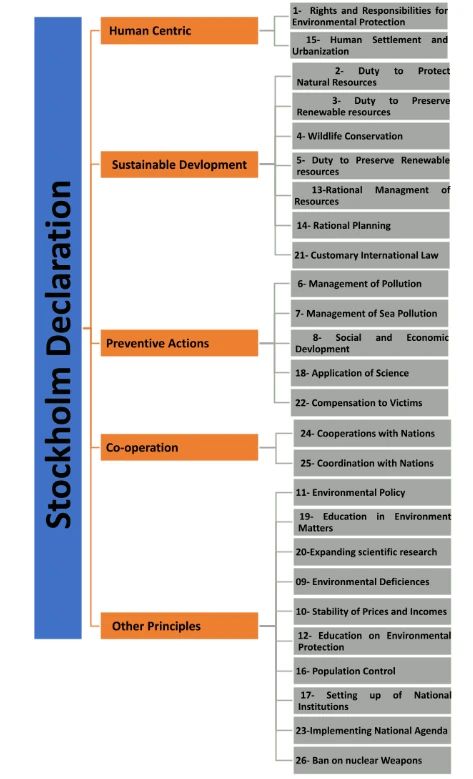
Human-centric:
Sustainable development:
Preventive actions:
Cooperation
Other principles
Principle 26: Ban on nuclear weapons – nuclear weapons are the most destructive weapons. They cause more damage to the environment than any other weapon. All the nations should come together to ban nuclear weapons.
© VIDHOON All Rights Reserved